
How Many SEO Articles Do You Need? A Traffic Concentration Study
TL;DR
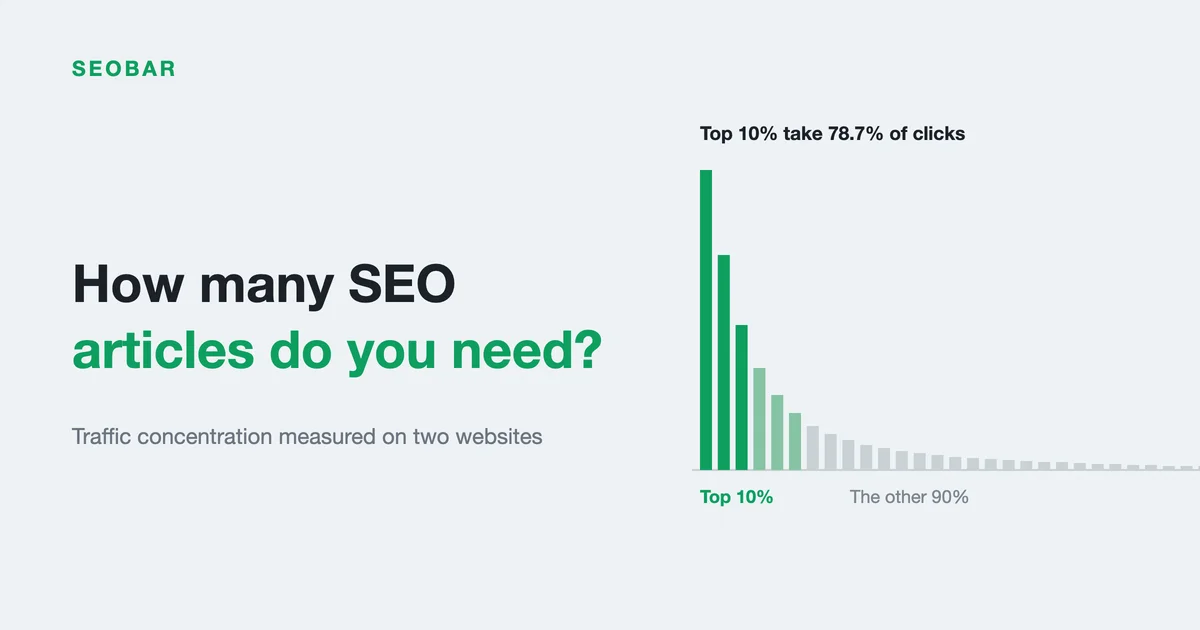
- On two websites I measured, the top 10% of articles took 63% and 46% of impressions, and 78.7% and 51.4% of clicks
- Concentration does not take years to appear. On a site with only five months and 53 articles, the top five posts already took more than half of all clicks
- The site with more articles was more concentrated, so writing more looks less like growing the pie and more like cutting the same pie into thinner slices
- Article count is the easiest unit to price and sign off on, which is why SEO contracts end up shaped like "N posts a month," regardless of how skilled the writer is
- Whether to write another post should depend on one thing: does this post target a query you can realistically win right now
Contents
SEO traffic distribution across articles
Content concentration and site age
Diminishing returns of publishing more SEO content
Per-article pricing in SEO contracts
Three questions before writing another SEO article
Limitations of this study
Introduction
Most SEO content contracts are priced per article, with a fixed number of posts delivered every month. After a while a question comes up that the contract never answers. If the articles keep piling up but traffic does not grow in proportion, is the 100th article really worth as much as the 50th?
That question can be measured, and the two sites below are the measurement. Both publish in Traditional Chinese for readers in Taiwan, which is worth stating because most published data on content performance comes from English-language sites. The pattern turns out to be the same.
SEO traffic distribution across articles
The top 10% of articles took most of the traffic on both sites. The data comes from the two sites I maintain with the most content. One has published 102 articles since June 2025; the other has 53 and only started in April 2026. They cover different topics for different audiences, and both are connected to Google Search Console.
Sorting each site's articles by impressions, from highest to lowest, gives this:
| Site A (102 posts / 15 months) | Site B (53 posts / 5 months) | |
|---|---|---|
| Share of impressions, top 10% of posts | 63.0% | 46.0% |
| Share of clicks, top 10% of posts | 78.7% | 51.4% |
| Share of impressions, top 20% of posts | 81.2% | 67.7% |
| Share of impressions, top 30% of posts | 89.7% | 83.9% |
On Site A, ten articles took close to 80% of clicks, and the other ninety-odd articles shared what was left.
This shape is a power-law distribution, where a small number of items account for most of the outcome. It is not surprising to see it in content, because only the first few positions for any query get meaningful attention, and most articles are not in the first few positions for anything.
Content concentration and site age
The gap between the two sites is the more interesting part, because it shows concentration is not something that builds up slowly over years.
Site B had been running for five months with 53 articles, and its top five posts already took more than half of all clicks. The distribution had this shape as soon as the first batch of articles was published.
Site A has twice as many articles as Site B, yet its top 10% take 27 percentage points more of the clicks. More articles led to more concentration, not a more even spread.
The reason is that each new article competes for queries that are already taken. Early posts go after the most obvious topics, which are also the ones with less competition at the time. By the 80th post the obvious topics are used up, and what remains is either more competitive or barely searched at all.
Diminishing returns of publishing more SEO content
Volume still matters, but its value lies in finding the 10% that win, not in the article count itself.
There is no reliable way to predict in advance which post will win. Eight recent articles on this site were built on the same technical setup, written by the same person and published in the same period, and their average positions ranged from 5.9 to 75.8. One of them still had zero impressions two weeks after publishing. You have to write enough to hit the topics that work, and that is the cost of exploration.
The problem starts after exploration is done. Once you can see which posts are bringing in traffic and which are not moving, spreading resources evenly to write the 103rd post has a lower expected return than investing in the existing winners. Moving a page from position 8 to position 3 usually brings far more clicks than one more article on a topic nobody searches for.
In some cases the added article has a negative return. When several articles on the same site target the same query, Google tends to alternate between them or pick a page the site owner never intended to rank, and none of them ends up ranking well. This keyword cannibalization becomes almost inevitable once a site passes a certain number of posts, and it never shows up in any error report, because each article looks fine when viewed on its own.
Per-article pricing in SEO contracts
Contracts like "eight articles a month" are common because they are the easiest to agree on, not because they produce the best results.
Article count is visible, countable and easy to sign off on. Other work is much harder to package. Merging three competing articles into one, rewriting the post sitting at position 8 to push it into the top three, or deciding that this month the right move is to publish nothing and fix cannibalization first all produce no new URL. The client opens the site and sees nothing new, and it is hard to put that work on a quote.
None of this means per-article services are unprofessional, since a provider's judgment and the shape of what they deliver are separate things. It does create a structural problem, though: when the billing unit is the article, nobody has a reason to say "I recommend we don't write anything this month," even when that is the right advice.
If you are the one buying, ask three things about each new article this month: which query it targets, who currently holds the top ten for that query, and whether any existing article on your site already targets it. If the provider can answer all three, the number of articles stops being the point.
Three questions before writing another SEO article
Which query is this article going after, and who ranks for it now? If the top ten are official documentation and large, long-established sites, even a well-written post will most likely get indexed and then sit there with no impressions. Targeting a more specific phrasing of the question usually works better than writing a longer version of the same topic.
Does the site already have an article targeting this query? If it does, the first option should be to make that article more complete rather than publish a new one, because two articles chasing one query usually means neither ranks.
Which existing articles sit between positions 5 and 15? This range offers the best return on effort, because these pages have already proven they can reach the candidate set, and moving them up a few positions usually adds more clicks than a new article starting from zero.
All three questions need Search Console data to answer. The difference between choosing topics by instinct and choosing them from data eventually shows up in the slope of that distribution curve.
Limitations of this study
This is data from two websites, which is not enough to generalize to all sites. Both are maintained by the same person using the same approach to topic selection, so other sites may be distributed differently.
Impressions and clicks come from Search Console, which anonymizes some long-tail queries, so actual numbers are slightly higher than reported. Article counts include published posts only and exclude page-type content.
The shape and degree of concentration change over time. The ratios above come from a single observation and are not stable constants.
FAQ
Does publishing more SEO articles bring more traffic?
Not in a linear way. On the two sites measured in this study, the top 10% of articles took 63% and 46% of impressions and 78.7% and 51.4% of clicks, while the remaining 90% shared the rest. The site with more articles was more concentrated, which suggests new articles compete for queries that are already taken and the marginal return falls.
Should I keep writing new articles, then?
Yes, as long as you treat volume as a way to find the 10% of topics that win. Nobody can reliably predict which article will rank, so you need enough attempts to hit the right topics. Once that exploration is done, shift resources: pushing articles already at positions 5 to 15 higher usually brings more clicks than another post on a topic nobody searches for.
Why are SEO content contracts usually priced per article?
Because article count is visible, countable and easy to sign off on. Merging competing articles, rewriting existing ones, or deciding not to publish this month produce no new URL, so the client sees nothing new and the work is hard to put on a quote. The structural result is that when the billing unit is the article, nobody has an incentive to recommend publishing nothing.
What is keyword cannibalization between articles?
It happens when several articles on the same site target the same query. Google tends to alternate between them or pick a page the owner did not intend, and none of them ranks well. It never appears in an error report because each article looks normal on its own; you find it by checking in Search Console which pages are receiving impressions for the same query.
Your site isn't showing up in search. Where is it stuck?
Crawling, indexing, ranking and AI citation are four separate gates, and which one you're stuck at decides what to do next. Send the URL and I'll look at it with real measurements before giving an answer.
More in Technical SEO
Keep reading on related topics
Comments
Only members can comment, to keep out spam. Comments appear on this page.