ChatGPT vs Gemini Citation Overlap: 17.8% in a 216-Sample Study
TL;DR
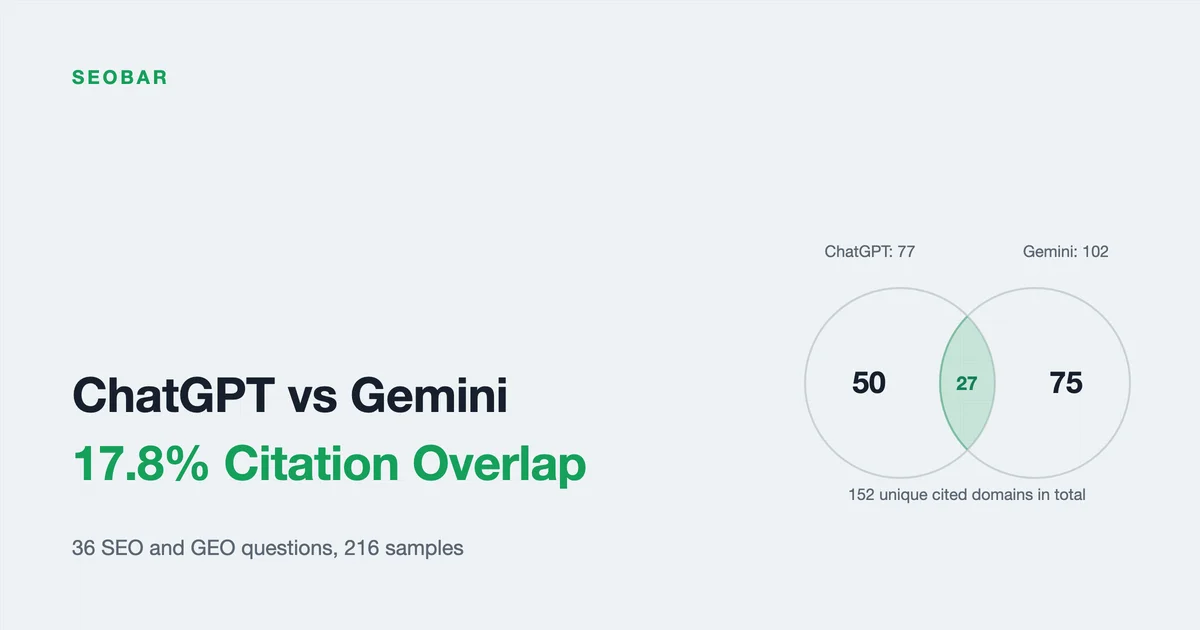
- Across 216 samples, ChatGPT and Gemini answering the same set of SEO questions shared only 17.8% of their cited domains
- When asked to recommend a company, both engines searched the web almost every time (96.3% and 92.6%); for how-to and concept questions, ChatGPT searched only 3.7% of the time and Gemini 66.7%
- The three question types drew on almost entirely different domains. Recommendation answers were dominated by content pages on a job board and an e-commerce platform, plus "best SEO agencies" listicles written by agencies themselves
- Citations for knowledge questions currently go to small personal blogs, including one with a Chinese-character domain name, not to high-authority sites
- One article targeting a keyword with no measurable search volume appeared in 5 of the 6 samples for its question, more often than several of Taiwan's largest agencies
- A day-30 rerun under identical conditions:
seobar.devstill had zero citations, overlap between the engines was 14.7%, and Gemini searched less often for all three question types - The raw data from the first round is published under CC BY 4.0; every number from that round can be recalculated from the two CSV files on the research page
Contents
Study Design: 36 Questions, Two AI Engines, 216 Samples
How Often ChatGPT and Gemini Search the Web, by Question Type
Citation Sources for "Recommend an SEO Agency" Questions
Citation Sources for How-To SEO Questions
ChatGPT vs Gemini Citation Overlap: 17.8%
A Zero-Search-Volume Keyword That Earned AI Citations
Limitations of This AI Citation Study
What the Results Mean for GEO Content Strategy
Day-30 Rerun: seobar.dev Citations and Overlap Rate
Why Measure When AI Assistants Search the Web
Most advice on "how to get cited by AI" assumes that the assistant looks something up whenever a user asks a question.
That assumption only holds some of the time. A generative assistant can answer in two ways: it can retrieve web pages in real time and list them as sources, or it can answer from what the model already knows and cite nothing. The difference is easy to miss in the interface, and most users never check whether an answer has source labels under it. For anyone producing content, though, the difference decides everything, because a question that never triggers retrieval cannot surface your page no matter how good it is.
This study asks a question that can be measured: when users in Taiwan ask about SEO and GEO (generative engine optimization), which kinds of questions make the AI search, and what kinds of pages end up cited.
The data comes from questions written in Traditional Chinese and sent from Taiwan. Almost all published GEO research is based on English queries in the US market, so this is one of the few datasets showing how ChatGPT and Gemini behave in a non-English market, where the pool of local sources is much smaller and the engines have to decide between local pages and English ones.
Study Design: 36 Questions, Two AI Engines, 216 Samples
The question set has 36 questions in three groups, based on what the user is trying to do:
| Group | Questions | Intent | Example (original Chinese, with English gloss) |
|---|---|---|---|
| Recommendation | 18 | Find someone to hire | 台灣有哪些不錯的 SEO 顧問或公司可以推薦? ("Can you recommend good SEO consultants or agencies in Taiwan?") |
| Knowledge | 9 | Learn how to do something | robots.txt 要怎麼設定才不會擋到 AI 爬蟲? ("How do I set up robots.txt without blocking AI crawlers?") |
| Comparison | 9 | Understand a difference or trade-off | GA4 跟 Google Search Console 差在哪?企業該先裝哪一個? ("What's the difference between GA4 and Google Search Console, and which should a business set up first?") |
Each question was run three times on ChatGPT and three times on Gemini, for 216 samples in total. Sampling ran from late on September 12, 2026 into the early hours of September 13, using the logged-out web interfaces, from the same machine and the same outbound IP address, so all 216 runs had identical conditions.
For 32 of the ChatGPT samples the answer text could not be captured, although their citation lists were captured in full. This does not affect the statistics in this article, because the answer text and the citation list are captured separately, and both "did it search" and every domain count below are based on the citation list. Counting only the samples with complete text, the search rates for the three question types are 97.6%, 6.7% and 5.3%, compared with 96.3%, 3.7% and 3.7% in the table below, and the difference changes none of the conclusions. I found the problem when rechecking the data on September 15, 2026; details are in the limitations section.
Each question was run three times because generative assistants answer with some randomness, and a single result does not represent how the engine usually handles a question. A separate public test (in Chinese) documented this: when the same questions were rerun 28 days later, only about 30% of the businesses recommended the first time were still on the list.
A sample counts as "searched" when its citation list contains at least one link to a content page on an external website. Links that belong to the interface itself (sign-in, help, map attribution) and map listings are excluded. This matters most for ChatGPT's recommendation answers, which often include a map panel, and counting map links as sources would overstate how often it searches. The same page also often appears several times in a citation list as different text fragments, so every page count has the fragment stripped from the URL and is deduplicated, to avoid counting one page more than once.
I also added seobar.dev to the list of domains being watched. The domain launched on August 27, 2026, so sampling day was day 17. It had no external links and had published ten technical articles built mostly on its own test data. Including my own site gives a clean starting point for a question established domains can't answer: how long does it take a zero-authority site that keeps publishing expert content with methods and data to show up among AI citations? With an established domain you can't tell whether the content is working or years of accumulated domain authority is doing the work.
How Often ChatGPT and Gemini Search the Web, by Question Type
| Question type | ChatGPT | Gemini |
|---|---|---|
| Recommendation (54 samples) | 96.3% (52/54) | 92.6% (50/54) |
| Knowledge (27 samples) | 3.7% (1/27) | 59.3% (16/27) |
| Comparison (27 samples) | 3.7% (1/27) | 74.1% (20/27) |
Recommendation questions were the only group where the two engines behaved the same way, triggering retrieval almost every time. The user wants a concrete list, and the model's internal knowledge can't supply verifiable information about businesses, so retrieval becomes necessary.
For knowledge and comparison questions combined, the gap between engines is large: only 3.7% (2/54) of ChatGPT samples cited any external source, against 66.7% (36/54) for Gemini. Asked what happens when a canonical tag is set incorrectly, Gemini usually listed a few sources while ChatGPT usually just answered.
This gap cuts both ways for content strategy. On ChatGPT, tutorial content has almost no route into the answer, since the user gets the model's existing knowledge, and the main lever a publisher has there is long-term entity building rather than real-time retrieval of individual articles. On Gemini, the same tutorial content has a clear, measurable citation path.
Citation Sources for "Recommend an SEO Agency" Questions
The 18 recommendation questions produced 102 answers with sources. Counting how many samples each domain appeared in, the top of each engine's list looks like this.
Gemini (50 samples with sources):
| Domain | Appearances | What it is |
|---|---|---|
| nabi.104.com.tw | 28 | Content platform run by 104, Taiwan's largest job bank |
| ibest.tw | 22 | SEO agency |
| winho.com.tw | 22 | SEO agency |
| hotspot.com.tw | 16 | Marketing agency |
| 91app.com | 15 | E-commerce SaaS platform |
ChatGPT (52 samples with sources):
| Domain | Appearances | What it is |
|---|---|---|
| nss.com.tw | 13 | Hosting and cloud provider |
| pro360.com.tw | 11 | Freelance services marketplace |
| stack.com.tw | 11 | Marketing agency |
| nabi.104.com.tw | 8 | Content platform run by 104, Taiwan's largest job bank |
| hotspot.com.tw | 7 | Marketing agency |
The cited pages were overwhelmingly one format: listicle-style roundups with titles like "Best SEO Companies of 2026" or "Top 9 SEO Agencies in Taiwan." Some were published on agencies' own domains, and the rest came from the content marketing sections of the job board and the e-commerce platform.
This is a hard position to compete for. The listicles are mostly written by agencies that have been operating for years, and the job board and e-commerce platform carry very high domain authority, so a newcomer is unlikely to displace them soon. The more realistic route is to get included in the existing listicles rather than write another one to compete with them.
Citation Sources for How-To SEO Questions
The sources cited for knowledge questions barely overlap with those for recommendation questions. In Gemini's 16 knowledge samples with sources, the most frequent domains were kyiplay.com, bigboycancode.com and tw.wfublog.com, with 3 appearances each, followed by reddit.com and blog.csdn.net (a Chinese developer blogging platform) with 2 each. The list also included a domain written in Chinese characters, 樂創約.tw.
What these domains have in common is that they are small, mostly personal technical blogs, a sharp contrast with the job board and e-commerce platform behind the recommendation answers. The same engine cites sources at completely different levels depending on the question type.
ChatGPT cited an external web page in only 1 of its 27 knowledge samples, too few to say anything about structure. What can be observed is that all 9 domains listed in that one answer were English-language sites, including international SEO media such as searchenginejournal.com, while Gemini answered the same questions mostly with Chinese-language sources. Confirming that contrast would take more samples, so I list it here only as an observation.
For a new website, citation slots for knowledge questions are a far more realistic target than recommendation slots. The sites holding them now are not high-authority, and most competing content has not been written with citability in mind.
ChatGPT vs Gemini Citation Overlap: 17.8%
After deduplicating every external domain cited across the 216 samples:
- ChatGPT cited 77 unique domains, 39 of them ending in
.tw(51%) - Gemini cited 102 unique domains, 41 of them ending in
.tw(40%) - The union is 152 domains, of which 27 were cited by both engines, an overlap rate of 17.8%
A .tw ending is only a conservative proxy for Taiwanese sources and undercounts Taiwanese sites on .com, so it shouldn't be read directly as the share of local sources. The overlap rate is not affected by this.
In practice, 17.8% means that "being cited by AI" is not a single state. Holding a citation slot on one engine does not mean you are visible on the other, and observations from one engine can't be extrapolated to overall performance. Judging brand visibility from a single query or a single platform will give a badly skewed picture.
A Zero-Search-Volume Keyword That Earned AI Citations
One of the test questions was 台灣做 GEO(生成式引擎優化)的公司有哪些? ("Which companies in Taiwan do GEO, generative engine optimization?"). Across its 6 samples, an article on ahha.tw appeared in 5 (all three ChatGPT samples and two of the three Gemini samples), more than awoo.ai (4), geomkt.app (4) and leaderweb.com.tw (3) in the same answers. The URL ChatGPT listed carried the source-tracking parameter the platform adds itself, which makes it a clickable citation rather than a text mention.
For disclosure, ahha.tw is owned by the operator of this site, so this is a result for my own site.
What matters here is not the ranking but the state of the keyword on the search side. Terms like "GEO consultant" and "AI SEO company" (in Chinese) return no data in keyword tools, and Search Console showed zero impressions for them. No search volume means nobody writes content for the topic, not that nobody asks the question, because people phrase questions to an assistant differently from how they type into a search box. When competitors decide what to write by sorting keywords by volume, topics with no data become empty territory.
This observation has a narrow scope. It is a single test of a single question and does not support a general claim that zero-volume keywords tend to earn citations. What it offers is something to check: whether your keyword planning process filters out topics people actually ask about but that tools can't measure.
Limitations of This AI Citation Study
- Each question was sampled only three times, in a single time window from a single location. Answers are random to some degree, and these results describe only this batch of observations.
- Only the logged-out web interfaces of ChatGPT and Gemini were tested. Logged-in sessions, paid plans and the APIs may behave differently.
- Recommendation questions are affected by where they are asked from. Even though the questions specified "Taiwan," both engines answered with businesses in the city where the test was run, so regional results can't be extrapolated to other areas.
- "Listed as a source" and "the answer is actually supported by that page" are different things. This study counts only the former; the latter would need manual annotation.
- Capturing citations depends on how the interface presents them at the time. A redesign can break capture, and a capture failure looks exactly like a change in behavior. In the pilot run, the capture code failed to pick up Gemini's source labels, which led to the false conclusion that Gemini never searched; after the fix, the rate for the same questions went from 0% to between 59% and 74%. Any comparison across time should first confirm that capture still works. It happened again in this round, when capture of ChatGPT's answer text failed during sampling and 32 samples were left with a citation list but no text. Nobody noticed at the time, and I only found it when rechecking the data three days later. A capture failure doesn't stop the run or log an error, which makes it the hardest bias in this kind of study to catch yourself.
What the Results Mean for GEO Content Strategy
Three conclusions can be applied directly.
Choose content format by question type, not keyword difficulty. Citation slots for recommendation questions are held by platform content pages and long-established agencies' listicles, which are hard to displace in the short term. Slots for knowledge questions are held by small sites, which makes them the more realistic entry point for a newcomer.
Measure visibility separately for each engine. With only 17.8% source overlap between the two engines, observations from one platform are not representative. To use AI visibility as a business metric, cover at least two engines and record the number of samples and the test conditions.
Don't pick topics by search volume alone. People ask questions differently from how they search, and some topics that keyword tools show no data for still get asked. Competition for those topics is usually thinner.
As for the new domain I added to the watch list, its first result was zero. seobar.dev did not appear in the citation list of any of the 216 samples, and it did not appear in the answer text either, which was available for 184 of them. For a domain that was 17 days old with no external links, this is the expected baseline rather than a measure of success. Without a baseline, there's no way to tell whether any later change comes from accumulated content or from sampling noise.
Day-30 Rerun: seobar.dev Citations and Overlap Rate
The second round ran on September 25 and 26, 2026, 13 days after the first, when seobar.dev was on day 29 to 30. The questions, engines, logged-out interfaces, machine and outbound IP were all the same as the first round. All 216 samples completed, and both answer text and citation lists were captured in full. Eight samples were rerun at midday on the 26th, because ChatGPT's logged-out interface stopped producing answers after roughly 100 consecutive queries and recovered after a few hours.
| Metric | Day 17 | Day 30 |
|---|---|---|
seobar.dev appearances (citation list) |
0/216 | 0/216 |
seobar.dev appearances (answer text) |
0/184 | 0/216 |
| Source overlap between engines | 17.8% (27/152) | 14.7% (21/143) |
| ChatGPT search rate: recommendation / knowledge / comparison | 96.3% / 3.7% / 3.7% | 98.1% / 0% / 3.7% |
| Gemini search rate: recommendation / knowledge / comparison | 92.6% / 59.3% / 74.1% | 81.5% / 40.7% / 51.9% |
seobar.dev still had zero citations, and this time that was confirmed against the full answer text as well. Search Console data from the same period explains why: since launch, no query other than the brand name had more than 10 cumulative impressions. Recommendation answers draw their sources from existing listicles, and Gemini picks sources for knowledge answers from search results, so both paths assume the site is already visible in search. The depth of methods and data in the content can't substitute for that step.
Overlap between the engines was 14.7%, below 20% like the first round's 17.8%, so the conclusion that visibility must be measured per engine stands.
Gemini searched less often for all three question types, falling from 79.6% to 63.9% overall, while ChatGPT kept its pattern of searching only for recommendation questions. Sample sizes for individual types are small, so the drop for any single type shouldn't be read on its own. Because the limitations section notes that capture failure and behavior change look identical, I checked this separately: in both rounds, Gemini answers without sources showed no trace of source labels in their text, which rules out a capture failure.
The cited sources themselves shifted considerably. Across both rounds, 216 unique domains were cited, and only 79 of them (36.6%) appeared in both. The leading domains, including nabi.104.com.tw, ibest.tw, hotspot.com.tw and winho.com.tw, stayed near the top both times, and the turnover was concentrated in the long tail of domains that appeared only a few times. The ahha.tw article mentioned above appeared in all 6 samples for its question.
The series was originally planned to continue on day 60 and day 90 but now ends at day 30. The day-30 results show that citations won't change meaningfully until the site builds visibility in search, and rerunning before then would only record the same zero again. The two rounds are kept as this domain's baseline.
The raw data from the first round is on the research page: 216 sample records and 560 rows of citation detail, with a data dictionary, classification rules and SHA-256 checksums, licensed under CC BY 4.0. Every percentage from the first round can be recalculated from those two files, and if you get a different result, I'd like to hear about it.
The previous test in this series measured a gate that comes earlier: ChatGPT took 7 days to start reading a new domain. Before content can be cited, it has to be readable.
FAQ
Do AI assistants always search the web before answering?
No, and the difference is large. In this 216-sample study of SEO questions asked in Traditional Chinese from Taiwan, both engines searched almost every time when asked to recommend a company (ChatGPT 96.3%, Gemini 92.6%). For how-to and concept questions, only 3.7% of ChatGPT answers cited an external web page, against 66.7% for Gemini. If a question doesn't trigger retrieval, even the most complete content can't make it into that answer.
Why do ChatGPT and Gemini cite different sources for the same question?
In this study the two engines cited 152 unique domains, and only 27 were cited by both, an overlap rate of 17.8%. For recommendation questions, Gemini cited mostly content pages on a job board and an e-commerce platform, while ChatGPT cited a different set of agencies and a freelance marketplace. Holding a citation slot on one engine does not mean you are visible on the other.
What kind of content should a new website write to get cited by AI?
Based on these observations, knowledge content is the more realistic target. Citation slots for recommendation questions are held by job boards, e-commerce platforms and long-established agencies' listicles, which are hard to displace soon, while slots for knowledge questions are held by small personal blogs with far less competition. This only helps if the engine retrieves for that kind of question: ChatGPT cited an external page in just 1 of 27 knowledge samples. The day-30 rerun also showed that Gemini picks knowledge sources from search results, so the path stays closed until the site has visibility in search.
How can I check whether my website is being cited by AI?
Cover at least two engines, run each question several times, and record when and where you tested. A single query is unreliable because answers are partly random, and recommendation questions also depend on location: even with "Taiwan" in the question, both engines in this study answered with businesses in the city where the test was run. Being listed as a source is also different from the answer actually being supported by that page.
Your site isn't showing up in search. Where is it stuck?
Crawling, indexing, ranking and AI citation are four separate gates, and which one you're stuck at decides what to do next. Send the URL and I'll look at it with real measurements before giving an answer.
More in Technical SEO
Keep reading on related topics
Comments
Only members can comment, to keep out spam. Comments appear on this page.