
Do FAQ and Schema Increase AI Citations? A 468K-Citation Study
TL;DR
- A University of Toronto study published in October 2026 tracked how ChatGPT, Gemini and Perplexity answered commercial questions every day for 90 days, covering 158,000 answers and 468,000 citations
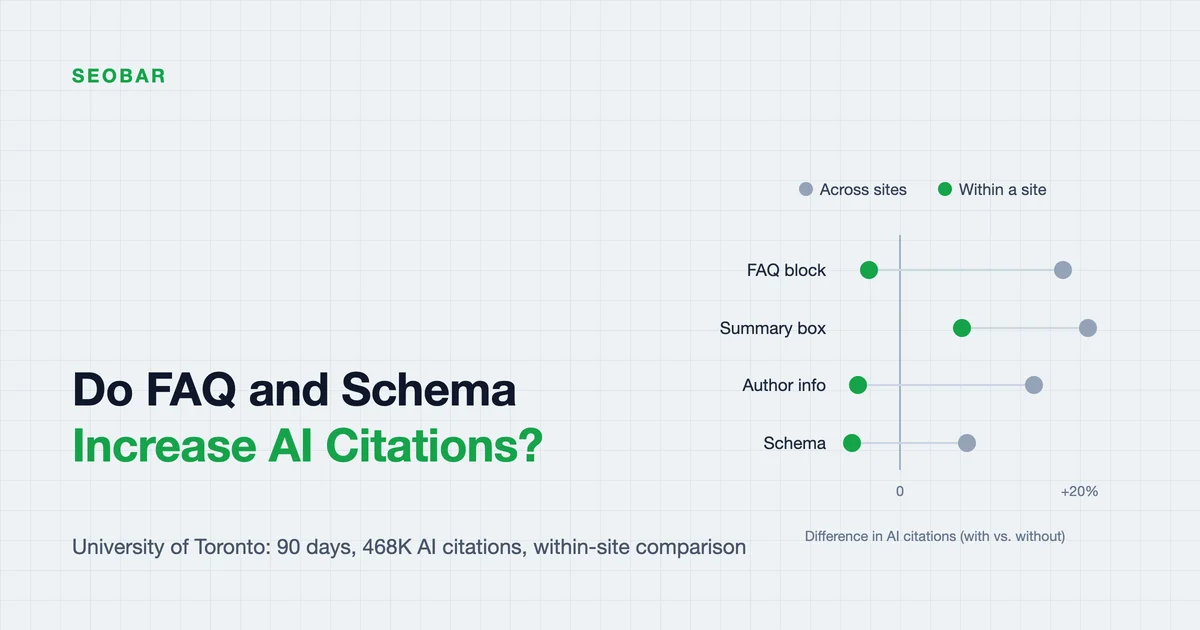
- Compared across websites, FAQ blocks, schema markup, author boxes and TL;DR summaries all correlate with more AI citations; compared between pages on the same website, none of them is significant
- Only two page features passed all five robustness checks, and both measure whether the title and the most relevant passage match the user's question
- Every page ChatGPT cited came from its own retrieval results, and 97% of those pages were outside Google's top 50. Retrieval explains 32% of the variation in citations, page features only 2.8%
- What the model already knows about a brand shapes both retrieval and the answer, and 47% of ChatGPT's citations point to sites it could name without searching
- The study used the API and English questions from the US market. Our Taiwan measurements on consumer interfaces point the same way on three findings: engines behave differently, recommendation questions lean on third-party lists, and cited sources turn over quickly. The FAQ and schema result has not yet been tested in a Chinese-language setting
Contents
Study design: 90 days and 468,000 AI citations
FAQ blocks, schema markup and author boxes: cross-site vs. within-site results
Page features linked to AI citations: titles and passages that match the question
AI retrieval vs. Google rankings
Brand recognition and AI recommendations
Comparison with AI citation data from Taiwan
Study limitations and conflict of interest
What the findings mean for GEO content
Introduction
Most GEO advice in circulation (GEO, or generative engine optimization, is the practice of making content more likely to be cited in AI answers) has settled into one checklist: add an FAQ block, add schema markup, show author information, open with a summary, and make the page faster. Each item comes with supporting numbers, usually in the form of "pages with an FAQ get X% more citations."
The sites that adopt these practices tend to be large, well-maintained sites to begin with, and large sites get cited more for reasons that may have nothing to do with an FAQ. Comparing pages that use a practice with pages that don't may only be measuring the gap between websites.
That is the problem addressed by What Drives AI Citations? Content, Retrieval and Model Knowledge in Generative Engine Optimization (GEO), a paper Mahe Chen and Nick Koudas of the University of Toronto posted to arXiv on October 10, 2026. They compared each page only with other pages on the same website, which removes the effect of the site itself, and once they did, every item on the checklist stopped working.
This post summarizes the paper and then sets it against the AI citation measurements I ran in Taiwan in September 2026 with Traditional Chinese queries. Almost all published GEO research uses English questions and the US market, so a second market is a useful check on which findings travel.
Study design: 90 days and 468,000 AI citations
The research team sent the same questions to three engines every day through their official APIs, with web search turned on:
| Engine | Model and search setting used in the study |
|---|---|
| ChatGPT | GPT-5.4 nano with the web search tool |
| Gemini | Gemini 3.1 Flash Lite, grounded in Google Search |
| Perplexity | Sonar |
The data covers two markets. The main dataset is US home internet service, with 651 questions, 143,249 answers and 396,188 citations. The second is proposal software for architecture and engineering firms, a niche market made up of small vendors, with 55 questions, 14,850 answers and 71,849 citations. Both were collected daily from June 24 to September 21, 2026.
The three engines cite in very different ways:
| Main dataset | ChatGPT | Gemini | Perplexity |
|---|---|---|---|
| Average pages cited per answer | 2.0 | 10.1 | 0.3 |
| Answers with no citations | 30.8% | 15.6% | 95.8% |
| Citations pointing to the brand's own site | 64.3% | 16.8% | 6.8% |
83% of Gemini's citations go to third-party sites, with Reddit alone accounting for 13%, while more than 60% of ChatGPT's citations go straight to brand websites.
The core of the design is a within-site comparison, in which each page is compared only with other pages on the same site. To guard against chance findings, a feature counted as real only if it passed five checks at once: correction for multiple comparisons, stable selection under resampling, a machine-learning estimate, the shape of the effect curve, and a consistent direction across several ways of slicing the data.
FAQ blocks, schema markup and author boxes: cross-site vs. within-site results
Compared across websites, the paper's results match standard GEO advice. In the table below, page speed is measured per one standard deviation (a statistical unit for the size of a difference, roughly "noticeably faster"), and the other rows compare pages with and without the feature:
| Practice | Across websites | Within the same website |
|---|---|---|
| FAQ block | +18.1% | −3.4%, not significant |
| Summary box (TL;DR, key takeaways) | +20.9% | +6.9%, not significant |
| Author information | +14.9% | −4.6%, not significant |
| Schema markup | +7.5% | −5.3%, not significant |
| Page speed | +11.7% | not significant |
Every cross-site figure is significant, and none of the within-site figures is. The reason is where the practices are concentrated. On the top quarter of sites by citations, 43% of pages carry an FAQ block, compared with 23% on the bottom quarter. FAQs and heavy citation show up together because both cluster on the same group of sites, not because the FAQ brings in citations. Statisticians call this Simpson's paradox, where a trend seen in pooled data reverses or disappears once the data is split into groups.
The niche market dataset shows the same pattern, with FAQ blocks at +22.5% across sites and −1.9% within sites.
The paper also looked at the stage where ChatGPT decides which retrieved pages to cite, comparing pages that held the same retrieval rank. Pages with an author box (odds ratio 0.77, where a value below 1 means a lower chance of being cited), an FAQ block (0.93) or schema (0.92) all had a slightly lower chance of being cited.
The paper measures AI citation counts only, so the role schema plays in Google rich results and entity recognition is outside its scope. Nor does it show that these practices do harm. It found no evidence that they increase AI citations once differences between websites are removed.
Page features linked to AI citations: titles and passages that match the question
Of the fourteen page features tested, only two passed all five checks, and both concern whether the page answers the question the user actually asked:
- Each one standard deviation increase in semantic similarity between the most relevant passage and the question brings 15.5% more citations
- Each one standard deviation increase in semantic similarity between the title and the question brings 14.1% more citations
- On third-party pages alone, the two figures are 25.7% and 23.6%
Word count, outbound links, number of headings, lists and tables had no effect. Older pages were cited less (−5.1% per standard deviation), but this did not hold up consistently across the checks.
The most relevant passage sat at a median of 45% of the way through the page, and only 32% of cited pages had it in the first quarter, so the engines find answers anywhere on the page, which runs against the common advice that the answer has to come first. Title match worked for Gemini (+16.8%) but was close to zero for ChatGPT, because ChatGPT rewrites the question into its own search queries instead of matching the original wording.
These similarity measures explain only a small share of the variation. Taken together, all page features explain 2.8% of the differences in ChatGPT citations between pages on the same site. When the data is split into odd and even days, about 75% of the variation repeats, yet no page feature accounts for it, which means citation is not random but is decided by something outside the page.
AI retrieval vs. Google rankings
The paper attributes the rest of the variation to the engine's own retrieval step. The team reran all 651 questions through the API and captured the search queries each engine sent, along with the list and order of pages it retrieved:
- 100% of the pages ChatGPT cited appeared in its own retrieval results (all 22,315 cited URLs). Pages it did not retrieve were never cited
- For each question, ChatGPT read 26 pages on average and cited 3. The page ranked first in retrieval was cited 43.8% of the time, falling to 12.2% for positions 6 to 10 and 3.5% for positions 11 to 20
- Retrieval data explains 32% of the variation in citations, compared with 2.8% for page features
ChatGPT splits a question into about four keyword-style queries, adding the current year to 23% of them and a brand name the user never mentioned to 28%. Gemini rewrites a question into about three natural-language queries that stay close to the original. When the same question was run twice on the same day, ChatGPT's queries overlapped by only 2.7% and its cited pages by 15%. This fan-out mechanism, where one question becomes several searches, is covered in more detail in ChatGPT fan-out queries (in Chinese).
AI retrieval barely overlaps with Google or Bing. 97% of the pages ChatGPT retrieved were not in Google's top 50, and 99% were not in Bing's top 30. Gemini is grounded in Google Search, yet 93% of the pages it cited were still outside Google's top 50. Half (51%) of the pages ChatGPT retrieved did come from sites that appeared in Google's top 50, though, so the two often draw on the same websites while picking different pages.
A high Google ranking does not mean AI will choose that page, but a site with no search visibility at all may never make it into the candidate pool.
Brand recognition and AI recommendations
The team also measured what the models already know by turning search off and asking them directly which brands and websites they would recommend for each question:
- 47% of ChatGPT's citations came from sites the model could name without searching
- A brand already known to the model ended up in ChatGPT's search queries 67% of the time, compared with 11% for brands it did not know
- When ChatGPT mentioned a brand the user had not asked about, 46% of those mentions had no cited page supporting the brand name, so they came from the model's memory
In a controlled experiment that held the product data fixed and changed only the brand name, rankings shifted. The same product description under a different name reached ChatGPT's top three anywhere from 39% to 80% of the time.
The niche market behaves the other way round. The model behind ChatGPT in the study could name these small vendors for only 2–16% of questions, so third-party pages matter far more. When a cited third-party page mentioned a vendor, the odds that ChatGPT named that vendor in its answer rose 39.7-fold, against 4.2-fold for the large brands in the main dataset. The paper concludes that well-known brands owe most of their visibility to what the model already knows, while small brands only hold a stable position when search can find third-party evidence about them.
Comparison with AI citation data from Taiwan
In September 2026, SEOBAR ran a public study of SEO and GEO questions asked in Taiwan: 36 questions in Traditional Chinese, the logged-out web interfaces of ChatGPT and Gemini, and two rounds of 216 samples each. The raw data is released under CC BY 4.0 on the dataset page. The two studies differ in language, market, interface and scale, so the numbers are not directly comparable, but the following observations point the same way.
ChatGPT looks things up less often for knowledge questions. In the Taiwan study, ChatGPT listed an external source for only 3.7% of how-to and concept questions, against 66.7% for Gemini. The paper's niche market consists almost entirely of questions about understanding product features, and there ChatGPT attached citations to only 35% of answers, compared with 69% in the main dataset. The numbers are far apart, but both show ChatGPT answering knowledge questions from its own model knowledge more often.
Citations for recommendation questions concentrate on third-party lists. In Taiwan, questions like "recommend an SEO company" drew citations mainly from job bank sites (such as 104, Taiwan's largest job board), content pages on e-commerce platforms, and "best SEO agencies" listicles written by other agencies. Most SEO providers in Taiwan are small brands the models barely know, which resembles the paper's niche market, and that is exactly where the paper found third-party pages to have the most influence. Both datasets point to the same approach: getting onto other people's lists gives a better chance of appearing in answers than writing yet another list of your own.
Cited sources change quickly, while the leading domains are relatively stable. The two Taiwan rounds were 13 days apart, and only 36.6% of the 216 cited domains appeared in both, with the turnover concentrated in the long tail. The paper splits its data into 14-day periods; two weeks later, about 40% of the variation was still shared for ChatGPT and 47% for Gemini, dropping to 14% and 29% after ten weeks. The two use different units, but both show that a single snapshot cannot represent normal behavior.
There is no Chinese-language comparison data yet for the FAQ and schema result. The Taiwan study did not have enough questions or samples for a within-site comparison, so that part remains to be tested.
Study limitations and conflict of interest
The paper lists its own limitations. The results are correlational, and while the within-site comparison removes site-level differences, it cannot remove unmeasured differences between pages on the same site. Pages were downloaded after data collection ended, so about a third of the cited URLs could not be analyzed. The retrieval rerun used the API, which may not match what ordinary users see in the ChatGPT and Gemini interfaces. Both datasets use English questions from the US market.
The study used small models, GPT-5.4 nano and Gemini 3.1 Flash Lite, and the models and retrieval settings behind consumer products may differ. The questions were written by customers of the research team's monitoring platform rather than sampled from real user searches. The data collection platform is run by the authors, the acknowledgments thank the ktau.ai team, and one of the paper's recommendations is long-term, question-by-question citation monitoring. This does not weaken the rigor of the method, but readers should know about the relationship. The paper is an arXiv preprint and has not been peer reviewed.
The within-site design has a blind spot of its own. If a site adds schema to every page through a template, there are no pages with and without schema to compare inside that site, so it contributes nothing to the schema estimate. The paper notes that brand sites are mostly built on shared templates and show little variation within the site, and no feature passed all five checks on brand pages. "No effect within a site" is not the same as "no effect when rolled out sitewide." There is currently no evidence that these practices make one page on a site get cited more, and this design cannot judge the effect of a sitewide rollout.
What the findings mean for GEO content
Write pages to match the question first. Whether the title and passages directly answer the question users actually ask is the only page factor that passed every check. The key passage does not have to sit at the top, but there should be one passage that answers the question on its own.
FAQ blocks, schema and author boxes are not shortcuts to AI citations. They serve other purposes, such as rich results, entity recognition and reader trust, and are worth keeping for those, but adding an FAQ block alone should not be expected to get a page cited by AI.
Being retrieved matters more than polishing the page. AI only cites pages it retrieves, and its retrieval barely overlaps with Google rankings. A site first needs basic search visibility, and then content that matches the queries AI rewrites the question into, such as queries with the year or a brand name added.
Small brands need third-party mentions. Brands a model does not know depend on third-party pages that mention them. Appearing in industry lists, comparison articles and press coverage does more than adding another layer of markup to your own site.
Monitor by engine and by question over time. Results from a single query or a single engine are not representative.
References
- Mahe Chen, Nick Koudas (2026). What Drives AI Citations? Content, Retrieval and Model Knowledge in Generative Engine Optimization (GEO). arXiv:2610.15033
- SEOBAR (2026). ChatGPT vs. Gemini AI citations: a 17.8% source overlap
- SEOBAR (2026). AI citation sources dataset (2026-09)
FAQ
Do FAQ blocks or schema markup make a page more likely to be cited by AI?
According to an October 2026 University of Toronto study, there is currently no evidence that they do. Compared across websites, pages with an FAQ block got 18.1% more citations and pages with schema 7.5% more; compared between pages on the same website, neither effect was significant. The gap exists because the practices are mostly adopted by sites that already get cited often. The study measured AI citation counts only, not the role of schema in Google rich results or entity recognition.
Which page features are linked to AI citations?
Of the fourteen features tested, only whether the title and the most relevant passage match the user's question passed all five robustness checks. Each one standard deviation increase in passage similarity brought 15.5% more citations, and in title similarity 14.1% more. Word count, outbound links, number of headings, lists and tables had no effect.
If a page ranks high on Google, will AI cite it?
Not necessarily. In the study, 97% of the pages ChatGPT retrieved were outside Google's top 50, and 93% of the pages Gemini cited were also outside Google's top 50. The engines often draw on the same websites as Google but pick different pages. ChatGPT only cites pages from its own retrieval, and retrieval explains 32% of the variation in citations compared with 2.8% for page features.
How can a small brand improve its chances of being recommended by AI?
The study's niche market shows that small brands the model does not know depend mainly on third-party mentions. When a cited third-party page mentioned a vendor, the odds that ChatGPT named that vendor rose 39.7-fold. Measurements in Taiwan likewise found that citations for recommendation questions concentrate on job bank sites, e-commerce platforms and recommendation lists written by other agencies.
Do the study's conclusions apply outside the US and to non-English content?
With caution. The study used English questions from the US market and reran retrieval through the API with small models, which may not match what consumers see in ChatGPT and Gemini. Measurements on consumer interfaces in Taiwan, using Traditional Chinese queries, agree on three points: engines differ, recommendation questions lean on third-party lists, and cited sources turn over quickly. There is no Chinese-language comparison data yet for the FAQ and schema result.
Your site isn't showing up in search. Where is it stuck?
Crawling, indexing, ranking and AI citation are four separate gates, and which one you're stuck at decides what to do next. Send the URL and I'll look at it with real measurements before giving an answer.
More in Technical SEO
Keep reading on related topics
Comments
Only members can comment, to keep out spam. Comments appear on this page.