
SEO · GEO Consulting

SEO and AI Search Optimization Built on Measurement

SEOBAR is a search consultancy led by Howshin Wang and operated by AHHA Digital Service Co., Ltd. in Taiwan. It provides search engine optimization and generative engine optimization (GEO) consulting grounded in hands-on technical work and measurement tools built in-house.

Abstract data network diagram with many lines converging on a single bright point

Latest Research

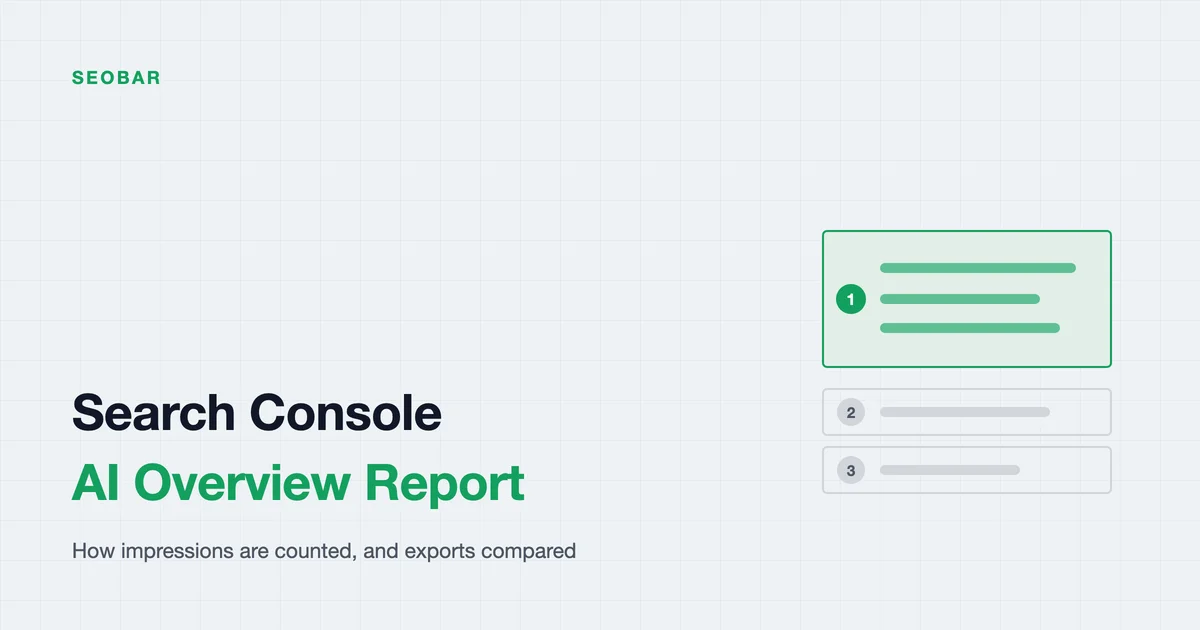
Light diagram: a green box at the top represents an AI Overview, with three links inside sharing position 1; below it, two grey boxes are ordinary search results at positions 2 and 3
Measurement & Tools

Search Console AI Overview Report: How Impressions Are Counted

The Search Console AI Overview report (Generative AI performance report) has one metric: impressions. Counting rules, opposite Search vs Discover deduplication, no API access, and page-level comparison steps.

October 30, 2026

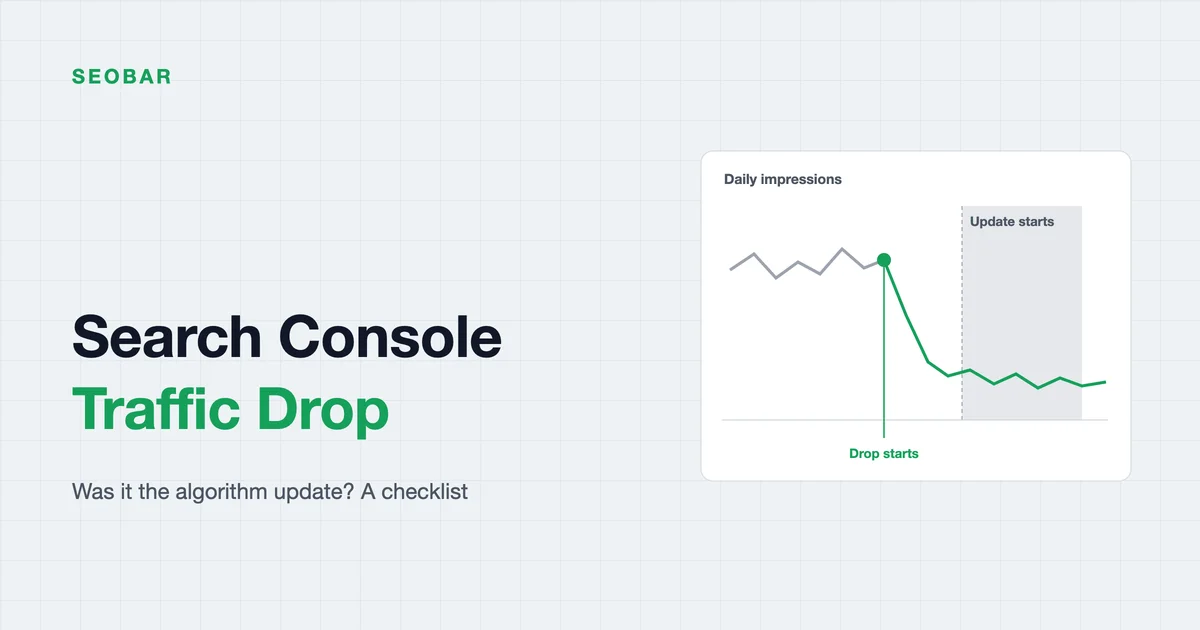
Line chart on a light background: daily impressions start falling at a green dot marking the start of the drop, and a gray shaded area to the right marks the update start, after the drop had already begun
Measurement & Tools

Traffic Drop After a Google Update? How to Confirm the Cause

A traffic drop in the same week as a Google algorithm update doesn't prove the update caused it. How to use the ranking update history, daily data and Search Console reports to rule out other causes first.

October 30, 2026

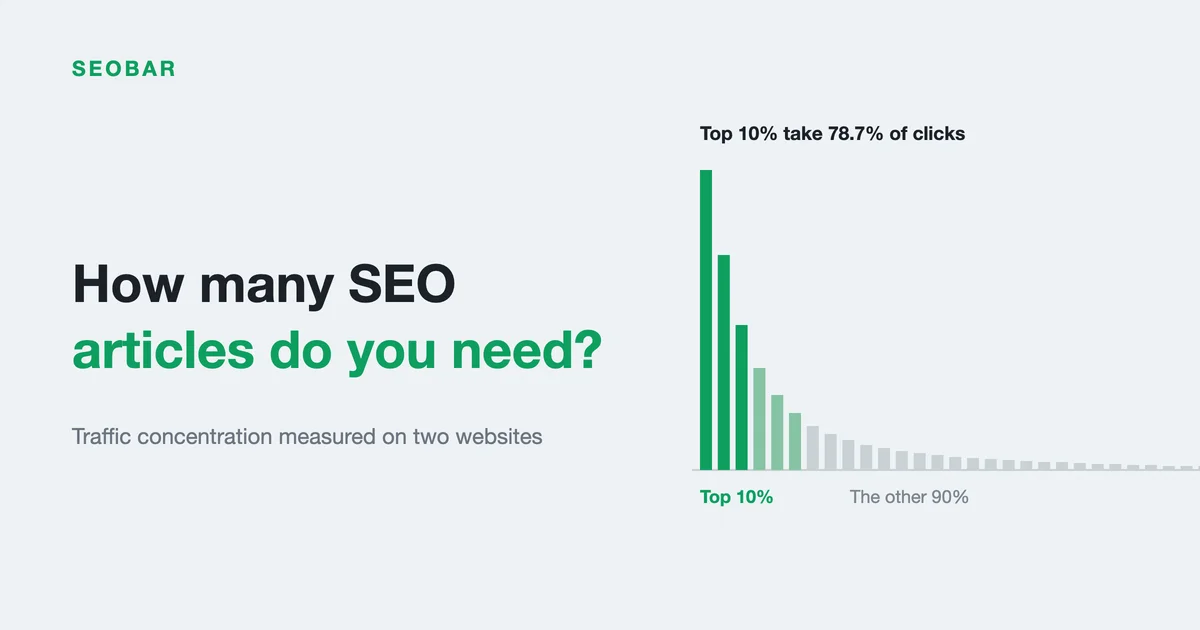
Light background bar chart: three tall dark green bars on the left stand far above the rest, followed by twenty-odd short light gray bars close to the baseline, labeled "Top 10% take 78.7% of clicks"
Technical SEO

How Many SEO Articles Do You Need? A Traffic Concentration Study

On two sites, the top 10% of articles took up to 78.7% of clicks, and the site with more posts was more concentrated. Why per-article SEO pricing persists, and three questions to ask before writing more.

October 30, 2026

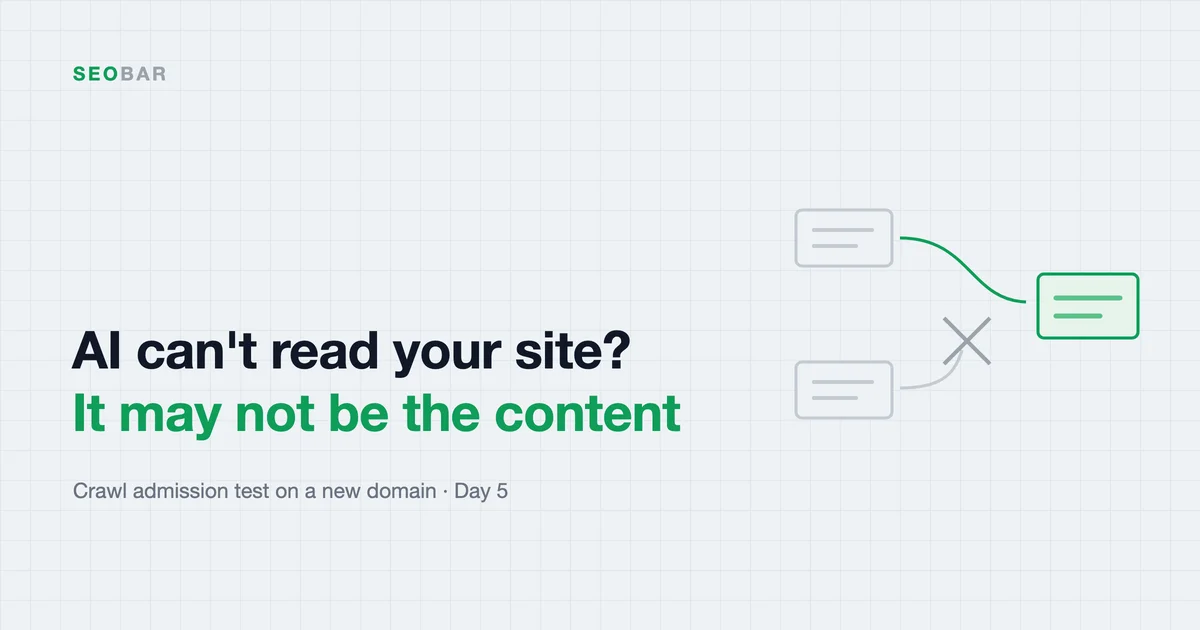
Light background diagram: two boxes representing websites on the left connect to a box representing AI on the right; one line is stopped partway by a grey X while the other passes through. Title reads "AI can't read your site? It may not be the content"
Technical SEO

ChatGPT Can't Read a New Domain at First: It Took 7 Days

On day 5, ChatGPT refused to open this new domain with "URL is not safe to open"; by day 12 it read the site and summarized it correctly. A test log of the crawl admission gate that sits before AI citation.

October 30, 2026

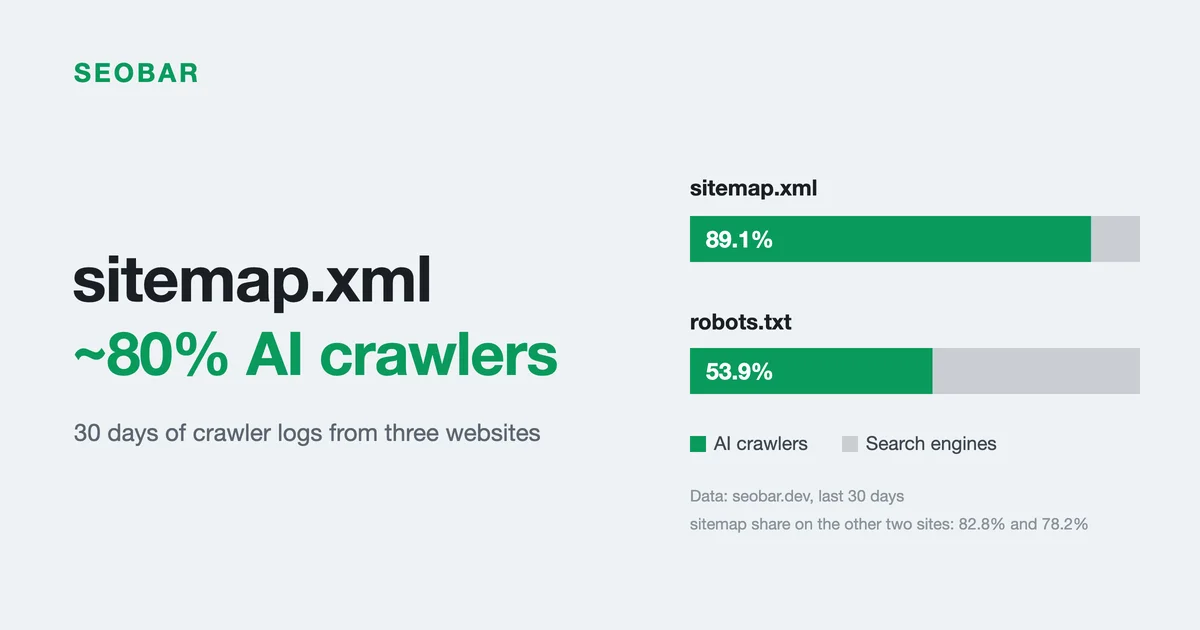
Light background bar chart: the sitemap.xml bar is 89.1% dark green (AI crawlers) and the robots.txt bar is only 53.9% dark green, with the rest in gray (search engines)
Technical SEO

AI Crawlers and sitemap.xml: 30-Day Log Data from Three Sites

30 days of crawler logs from three sites: AI crawlers requested sitemap.xml 3.6 to 8.2 times as often as search engines, while robots.txt split nearly evenly. On a 15-page site, half of all crawls hit these two files.

October 30, 2026

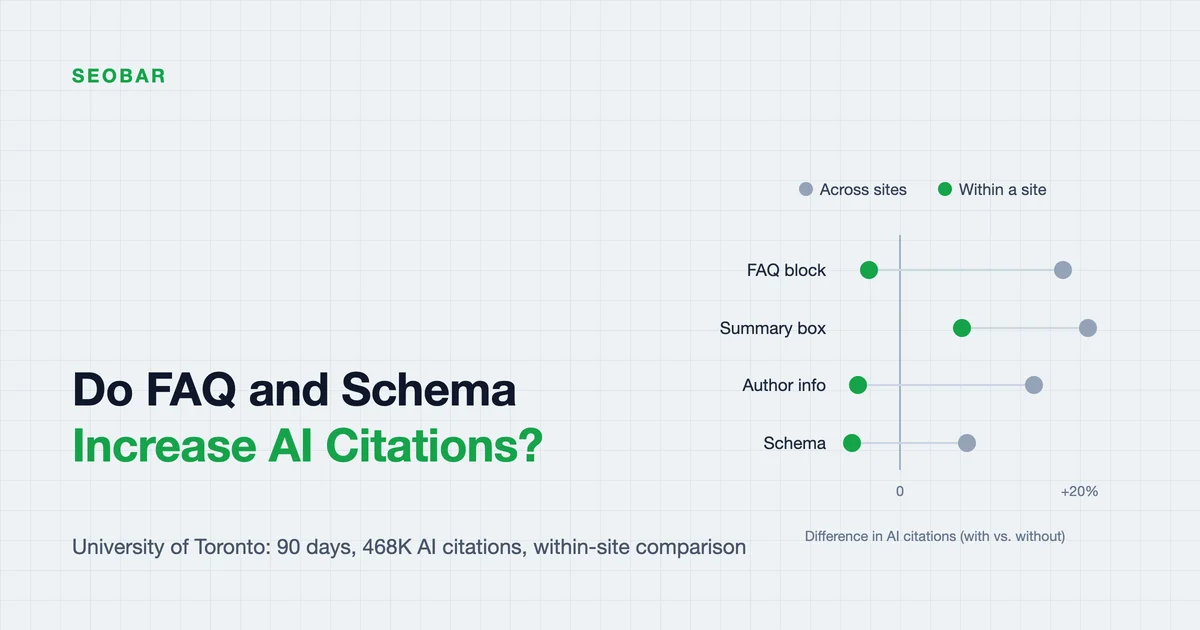
Dot plot on a light background with four rows: FAQ block, summary box, author info and schema. Gray dots show the cross-site difference in AI citations (all positive, +7.5% to +20.9%), green dots show the within-site comparison (−5.3% to +6.9%, none significant). Title on the left reads "Do FAQ and Schema Increase AI Citations?"
Technical SEO

Do FAQ and Schema Increase AI Citations? A 468K-Citation Study

A University of Toronto study of 468,000 AI citations found FAQ blocks, schema and author boxes have no effect within the same site. Title and passage match did. With a comparison against Taiwan data.

October 30, 2026

2022

Year AI research began

3 years

Researching AI search and GEO

I809962

Taiwan invention patent (co-inventor)

Dozens

Technical books translated and published

Three Working Principles

What separates SEOBAR from a typical search marketing service.

Technical work handled directly

Structured data, llms.txt, index management and load performance are engineering work at heart. SEOBAR has a development background, so these can be inspected and changed directly instead of waiting on a separate engineering team.

  • Schema.org structured data and entity recognition
  • llms.txt and readability for AI agents
  • Index coverage, canonicals and site architecture
  • Load performance and Core Web Vitals
Measurement tools built in-house
Measurement tools built in-house

Limitations stated up front

Limitations stated up front

Why Start with Measurement

What makes search engine optimization hard is that most outcomes cannot be traced back to a cause. A ranking change can come from an algorithm update, a competitor's changes, seasonal shifts in demand or something on the site itself, and without baseline data and repeated observation any attribution is a guess.

Generative engine optimization (GEO) is even less certain. Answers from generative systems are partly random, and asking the same question several times can return different lists, so a single observation is not enough to judge anything. In our own measurements, when the same set of questions was asked again twenty-eight days later, only about a quarter of the businesses recommended the first time were still on the list.

SEOBAR therefore sets up measurement first and optimizes second:

  • Get a baseline: Search Console impressions and average position, real keyword search volume, and which sources and businesses AI engines currently cite and mention
  • Observe repeatedly: sample the same question many times and compare across periods to tell trend from noise
  • State the limits: sample size, number of observations and what could not be measured

All the tools used for this are built in-house. AI citation tracking samples generative engines with the kinds of questions ordinary consumers ask and records the full answer, the cited sources and the businesses mentioned; the keyword tool puts real search volume next to existing Search Console impressions and positions. Building the tools ourselves means they can be rerun across periods, producing time series instead of one-off snapshots.

This process does not guarantee any particular ranking. What it does guarantee is that every change has observations behind it, so whether it worked can be checked.

From Long-Tail Keywords to Head Terms

The order decides how efficiently resources are spent.

Baseline audit

Collect Search Console data, real keyword search volumes and current AI engine citations to set a baseline for later comparison, since optimization without a baseline cannot be verified.

Long-tail entry

Start with specific, lower-volume questions that face less competition. These rank faster and give feedback within weeks while topic coverage builds up.

Topic coverage

Organize long-tail content by topic and link it into clusters, because search engines and generative systems judge expertise by overall coverage rather than by any single page.

Move up to head terms

Once topical authority has built up, use pillar pages to go after the high-volume head terms. Done in the reverse order, the budget goes into keywords that cannot rank in the short term.

Frequently Asked Questions

Q.How long does SEO take to show results?

It depends on how competitive the keyword is. For specific, less contested questions, changes in impressions usually show within a few weeks to two months; high-volume head terms usually take six months or more, and no specific position can be guaranteed. Trends in impressions and average position are a more reliable signal than traffic alone.

Q.How is GEO different from SEO?

SEO aims for positions in search results, while GEO aims to have content cited inside answers from generative systems. The technical foundations overlap heavily, since content has to be retrievable, clearly structured and accurate in both cases. They differ in how they are measured, because GEO has no rankings to look at and can only be tracked by sampling the same questions repeatedly and counting how often a brand is mentioned or cited.

Q.Does my current website need to be rebuilt before optimization?

In most cases, no. Technical issues such as structured data, index settings, load performance and internal linking can usually be fixed on the existing site. A rebuild is needed mainly when the site architecture itself blocks content from growing, or when the platform cannot output the necessary technical markup, and this is confirmed during the baseline audit.

Q.Can you guarantee keyword rankings?

No. Rankings are decided by search engines and generative systems, and no third party controls them. What can be promised is that every change has observations behind it and that each stage comes with measurement results you can check.

SEO / GEO Consulting Inquiries

Inquiry Form

Please sign in to leave a message (helps prevent spam)

✓

Thank you for your message

Your message has been sent. We will reply as soon as possible.

GEO Research Group (Facebook, in Chinese)

A monthly AI search experiment, with methods and results shared openly in a Traditional Chinese Facebook group.

Get SEOBAR Research Updates

Occasional emails with new SEO, GEO and AI search data and findings.

Used only to send SEOBAR research. Unsubscribe at any time.

You're subscribed. Thanks for following along.