
Traffic Drop After a Google Update? How to Confirm the Cause
TL;DR
- A traffic drop that lines up with a Google algorithm update meets a necessary condition, not a sufficient one, so the timing alone does not prove the update caused it
- Between January 1 and October 11, 2026, about 18% of all days fell inside the rollout of some web search ranking update, and adding the one-week waiting period Google recommends pushes that share close to 30%
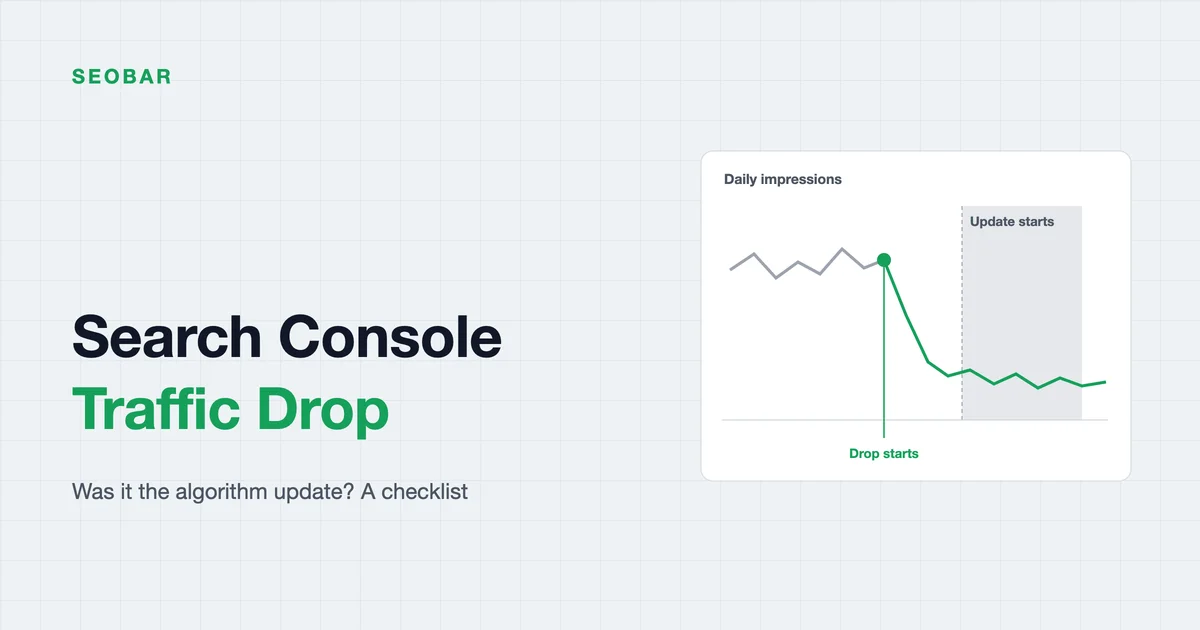
- The start of a drop has to be read from daily data, because week-over-week comparisons blur it; if the decline began before an update started, that update is ruled out
- For sites with single-digit daily impressions, the before-and-after gap usually sits inside normal fluctuation, which means the drop can neither be attributed to the update nor ruled out
- Technical problems, manual actions, security issues, shifts in search interest and site moves are all easier to verify than an algorithm update and should be eliminated first
- Core updates and spam updates are read differently: the first is about where your content quality stands relative to other pages, the second about whether you violate the spam policies
Contents
Google algorithm update dates and rollout periods
How often a traffic drop overlaps an algorithm update
Finding the start date of a traffic drop
Noise range on low-impression sites
Causes of a traffic drop other than an algorithm update
Core update vs spam update diagnosis
Search Console traffic drop checklist
Limits of this method
Introduction
When the Search Console performance report shows a clear decline and Google announced an algorithm update the same week, the conclusion that the site was hit by the update forms almost on its own.
That inference is everywhere in the SEO community, and replies to help-forum posts lean on it all the time, yet it only checks whether two dates are close together. Nobody has checked whether the decline started after the update began, whether its size goes beyond the site's usual swings, or whether other causes were eliminated first.
Google algorithm update dates and rollout periods
Google lists every announced ranking update in the Search Status Dashboard's ranking update history. Each entry has a start date and a rollout duration, with times given in US Pacific Time.
Rollout lengths vary a lot. These are the web search ranking updates announced so far in 2026:
| Update | Start date | Rollout duration |
|---|---|---|
| March 2026 spam update | March 24 | 19 hours 30 minutes |
| March 2026 core update | March 27 | 12 days 4 hours |
| May 2026 core update | May 21 | 11 days 21 hours |
| June 2026 spam update | June 24 | 2 days 1 hour |
| August 2026 spam update | August 18 | 2 days 16 hours |
| September 2026 spam update | September 24 | 13 days 16 hours |
The same page also lists a Discover update in February. It affects only Discover, not web search results, so it is left out here.
The rollout period matters because an update does not take effect on its start date all at once; it is applied gradually to different sites and queries across the whole window. Google's core update documentation also recommends waiting at least one full week after the rollout finishes before analyzing anything (Google Search's core updates). For a 12-day core update, that puts nearly twenty days between the start and the point where analysis makes sense.
How often a traffic drop overlaps an algorithm update
Laying the rollout periods from the table onto a calendar produces a number that rarely gets mentioned: of the 284 days from January 1 to October 11, 2026, 52 fell inside the rollout of some web search ranking update, about 18%. If each update also gets the one-week observation period Google recommends, the covered days rise to 84, about 30%.
The count runs from each update's start date through the day its rollout ended (partial days count as a full day), and days where updates overlap are counted once. Because end dates are rounded up, the share is slightly inflated, but the order of magnitude does not change.
Pick any day in 2026 and roughly one day in every three to five has an update that "matches the timing." Site traffic rises and falls for all kinds of reasons anyway, so any decline that happens on one of those days will always have an update to pin it on. The timing condition is met so easily that it cannot, on its own, separate a real update impact from coincidence.
Unannounced updates have to be considered too. The core update documentation states that Google also makes smaller updates regularly without announcing them, so a drop that matches no announced date is not necessarily unrelated to the algorithm. It just cannot be tied to any specific announcement.
Finding the start date of a traffic drop
The most effective way to rule an update out is to show that the drop started before the update's start date. An update that had not begun rolling out cannot be the cause.
The start has to be read from daily data. Search Console's default date range and week-over-week comparisons compress a gradual decline into two averages, and the starting point disappears. In practice, widen the date range (Google suggests the last 16 months, which also exposes yearly cycles), use the daily impressions and clicks lines to find the day the decline actually began, and then compare it with the start dates in the ranking update history.
Take a site that normally gets twenty or thirty impressions a day. Its blog impressions had already dropped to single digits per day five days before a spam update began. Comparing the total for the week before the update with the week after gives the conclusion that impressions collapsed after the update, but the daily view shows the decline happened before it, so that update can be ruled out immediately.
Two details matter when you line up the dates. The ranking update history uses Pacific Time, and the performance report also records daily data in California local time (performance report help), so the two can be compared directly without converting to your own time zone. Performance data also usually takes two to three days to appear, which means the most recent days may be incomplete and should not be treated as evidence of a decline.
Noise range on low-impression sites
The second thing to check is size. On a site with single-digit daily impressions, the numbers jump around by themselves: the same page can get 1 impression today, 6 tomorrow and 0 the day after with nothing changed at all.
At that scale, "impressions fell from 5 a day to 2 after the update" is not evidence. Look first at the range the daily numbers occupied in the few weeks before the update started, then check whether the post-update numbers clearly break out of that range. If they do not, the only defensible conclusion is that it cannot be determined, because the drop can neither be attributed to the update nor ruled out.
This limit matters most for new and very small sites. They are the most likely to read an ordinary fluctuation as an algorithmic penalty and then respond with expensive moves such as rewriting content wholesale or deleting pages.
Causes of a traffic drop other than an algorithm update
Google's guide to debugging drops in Search traffic sorts the causes into six categories, and algorithm updates are only one of them. The other five leave direct evidence in Search Console or public tools, which makes them easier to verify than an update, so they should be eliminated first:
| Cause | Where to check | Typical pattern |
|---|---|---|
| Technical issues | Crawl Stats report, Page indexing report | Server errors or a broken robots.txt cause a sitewide drop all at once; an accidental noindex makes specific pages disappear gradually |
| Security issues | Security issues report | Clicks fall sharply once the site is flagged for malware or phishing |
| Spam and manual actions | Manual actions report | Policy violations lead to lower rankings or the whole site vanishing from results |
| Seasonality and changing search interest | Performance report filtered by query, compared with Google Trends | Search volume for the same queries falls across the web, not just for your site |
| Site moves | URL Inspection, Page indexing report | Traffic dips until the new URLs are recrawled and indexed, which can take weeks for a mid-sized site |
Search Console also has a data anomalies page that records logging or processing problems on Google's side. Sometimes a drop in the report is only a logging issue and the site's real traffic never changed.
The performance report itself can narrow things down. When impressions and clicks fall together, the site is appearing in search results less often, and any of the causes above is possible. When only clicks fall while impressions hold steady, the problem more likely lies in the title, the snippet or other search features taking clicks away, and has nothing to do with rankings.
Core update vs spam update diagnosis
Once those causes are ruled out and the start of the drop really does fall inside an update's rollout, the next step is to identify which kind of update it was, because core updates and spam updates work differently and are read differently.
A core update is a reassessment of overall content quality. Google's documentation separates responses by how far rankings moved: a small drop, such as from position 2 to 4, does not call for major changes, while a large one, such as from position 4 to 29, warrants a broad review of the whole site and the most affected pages. It also points out that pages that drop are not necessarily "bad"; other pages may simply have been judged more relevant. How long improvements take to show up is not fixed, and sometimes it takes until the next core update.
A spam update is a change to Google's spam detection systems. It targets behavior that violates the spam policies, such as link schemes, mass-produced low-quality content and hidden text. Google's advice is that sites that see changes after one should review their own compliance against those policies (Google Search spam updates).
If a site has never done anything the policies list, a spam update was unlikely to be the cause in the first place, and matching dates do not make it more likely. If the site did buy links, though, the documentation states that the ranking benefit those links provided is lost once the system neutralizes them and cannot be recovered by fixing anything, and that after a violation is corrected the systems may need months to reflect it.
Search Console traffic drop checklist
Arranged as a sequence, the checks above run from the easiest evidence to the hardest:
- Check the Search Console data anomalies page to make sure it is not a logging problem on Google's side
- Check the Manual actions and Security issues reports
- Check the Page indexing and Crawl Stats reports for errors that appeared at the same time
- Filter the performance report by query and compare with Google Trends to see whether search interest fell across the whole market
- Use daily data to find when the drop started and compare it with start dates in the ranking update history; if the drop came first, rule that update out
- Compare against the fluctuation range from the weeks before the update to see whether the decline goes beyond normal swings
- Only if none of the above rules it out, read it by update type: for a core update, wait until a week after the rollout ends before analyzing; for a spam update, check compliance against the policies
The first four usually produce an answer within minutes. The real time goes into steps 5 through 7, and those three are also the ones most often skipped.
Limits of this method
This sequence is good at ruling things out and weak at confirming them. It can tell you that a particular update cannot be the cause, or that the drop is too small to support any conclusion, but even when every check passes, the most you can say is that a connection to that update is more likely. It cannot prove causation, because Google does not tell individual sites how they were assessed in an update and only the results are visible from outside.
Unannounced smaller updates also mean a timing mismatch cannot fully rule out the algorithm. For most sites the practical approach is to treat attribution as a question of probability: eliminate the causes with the clearest evidence first, then decide whether to touch content based on what remains, instead of stopping the moment you find an update whose dates line up.
The next time the performance report shows a decline, start with one cheap step. Set the date range to 16 months, switch to the daily view, note the date the drop actually began and compare it with the ranking update history. That step alone rules out a sizable share of misdiagnoses.
Sources
- Search Status Dashboard: ranking update history
- Google Search Central: Debugging drops in Google Search traffic
- Google Search Central: Google Search's core updates
- Google Search Central: Google Search spam updates
- Google Search Central: Spam policies for Google web search
- Search Console Help: Data anomalies in Search Console
- Search Console Help: Performance report
FAQ
If my traffic dropped at the same time as a Google algorithm update, does that mean the update caused it?
Not necessarily. Matching dates are a necessary condition, not a sufficient one. Between January 1 and October 11, 2026, about 18% of days fell inside the rollout of some web search ranking update, and close to 30% once Google's recommended one-week waiting period is added, so almost any decline can be matched to an update. You also need to confirm the drop started after the update began, that it exceeds normal fluctuation, and that technical issues, manual actions and changes in search interest have been ruled out.
Where can I find the dates of Google algorithm updates?
Google's Search Status Dashboard has a ranking update history listing the start date and rollout duration of every announced update, with times in US Pacific Time. The Search Console performance report records daily data in California local time, so the two can be compared directly.
How long after a core update can I tell whether my site was affected?
Google recommends waiting at least one full week after a core update finishes rolling out before analyzing it in Search Console, then comparing the week after the update ended with the week before it began. Both core updates in 2026 took more than 11 days to roll out, so nearly twenty days passed between the start and the point where analysis made sense.
My site gets very few impressions. How do I tell whether an algorithm update affected it?
With single-digit daily impressions, the numbers swing widely on their own. Check the range the daily figures stayed in for the few weeks before the update, then see whether the post-update numbers clearly fall outside it. If they don't, the only conclusion is that it can't be determined: the drop can neither be attributed to the update nor ruled out, and it is not a good reason to rewrite or delete content.
Can a spam update affect my site if I never bought links?
Spam updates target behavior that violates Google's spam policies, such as link schemes, mass-produced low-quality content and hidden text. If your site has never done anything the policies list, a spam update was unlikely to be the cause to begin with, and matching dates do not make it more likely, so check other causes first.
More in Measurement & Tools
Keep reading on related topics
Comments
Only members can comment, to keep out spam. Comments appear on this page.